
 Português
 English
 Español
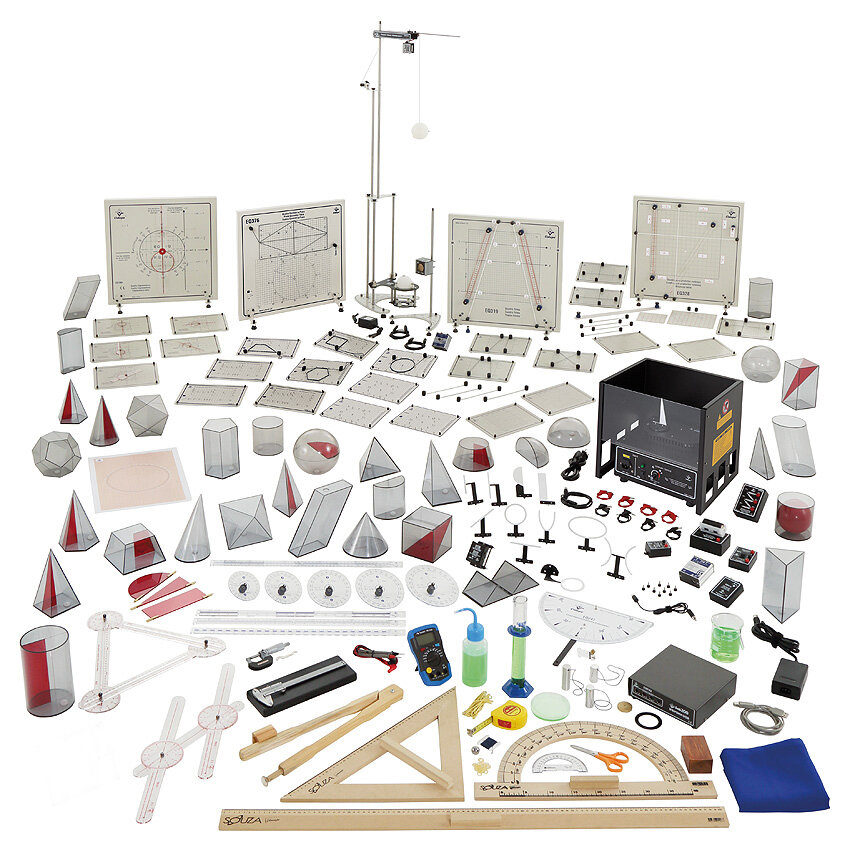
Master math unit with sensors, software and interface.
Code: EQ129H

Function
Intended for experimental study, mathematics laboratory and conducting mathematical experiments on: Mathematics. Statistics. Significant figures and uncertainties. Functions. What are the characteristics of the quadratic function? With an ultrasonic position sensor. What are the characteristics of the sinusoidal function? With an ultrasonic position sensor. What are the characteristics of the reciprocal function? The exponential function. Algebra. The notable product of the square of the sum of two terms, with a table. The notable product of the square of the sum of two terms. The notable product of the square of the difference of two terms, with a table. The notable product of the square of the difference of two terms. Trigonometry. The degree, the radian, the quadrants and their conversions. The sine in the trigonometric circle. The degree, the radian, the quadrants and their conversions. The sine in the trigonometric circle. The cosine in the trigonometric circle. The cosine in the trigonometric circle. The tangent in the trigonometric circle. The tangent in the trigonometric circle. The fundamental trigonometric relationship in the trigonometric circle. The fundamental trigonometric relationship in the trigonometric circle. The angular properties of triangles. The fundamental trigonometric relationships of the right triangle. The Pythagorean theorem, a metric relationship between the sides of a right triangle. The law of sines and cosines in a right triangle. Measuring the height of a distant object, the clinometer. Plane and metric geometry. The value of the constant pi. The relationships between the angles formed by parallel lines intersected by a transversal line. How to obtain the number pi in the circumference? Thales' Theorem, ratio and proportion. Thales' Theorem, intersection, ratio and proportion. Thales' Theorem and similar triangles. Thales' Theorem and similar triangles. How to obtain polygonal lines, quadrilateral and trilateral polygons and their perimeters. How to obtain polygonal lines, quadrilateral and trilateral polygons and their perimeters. How to find the areas of rectangles, squares, and triangles? How to find the areas of parallelograms, trapezoids, and rhombuses? How to find the areas of quadrilaterals and trilaterals? The Pythagorean theorem. The Pythagorean theorem. Spatial and metric geometry. Indirect volume measurement. Right and oblique prisms, the area of a right quadrangular prism (parallelepiped). Regular right and irregular pyramids, the area of a regular right pentagonal pyramid. The area of a right circular cylinder. The sphere and the area of a sphere inscribed in a cylinder. Area of a regular hexahedron, the cube. The solid of revolution obtained by rotating a rectangle, the right cylinder. The solid of revolution obtained by rotating a right triangle, the right cone. The cone of revolution intercepted by a plane, the truncated cone. The conical surface of revolution intercepted by a plane, conic sections, curves. The sphere of revolution obtained by rotating a semicircle and the spherical cap. The conical shell resulting from the revolution of an inclined line. The cylindrical shell resulting from the rotation of a vertical line. The disk resulting from the rotation of a horizontal line. The circular ring, torus, or toroidal surface, resulting from the rotation of a circumference. The spherical shell resulting from the rotation of a circumference around one of its diameters. The paraboloid of revolution or circular paraboloid, resulting from the rotation of a parabola. The ellipsoid resulting from the rotation of an ellipse. The external, internal, and wall volumes of a hollow cube. The pyramids, the external, internal, and wall volumes of a hollow pentagonal regular pyramid. The prisms, the external and wall volumes of a hollow right quadrangular prism, etc.
Quote product