
 Português
 English
 Español
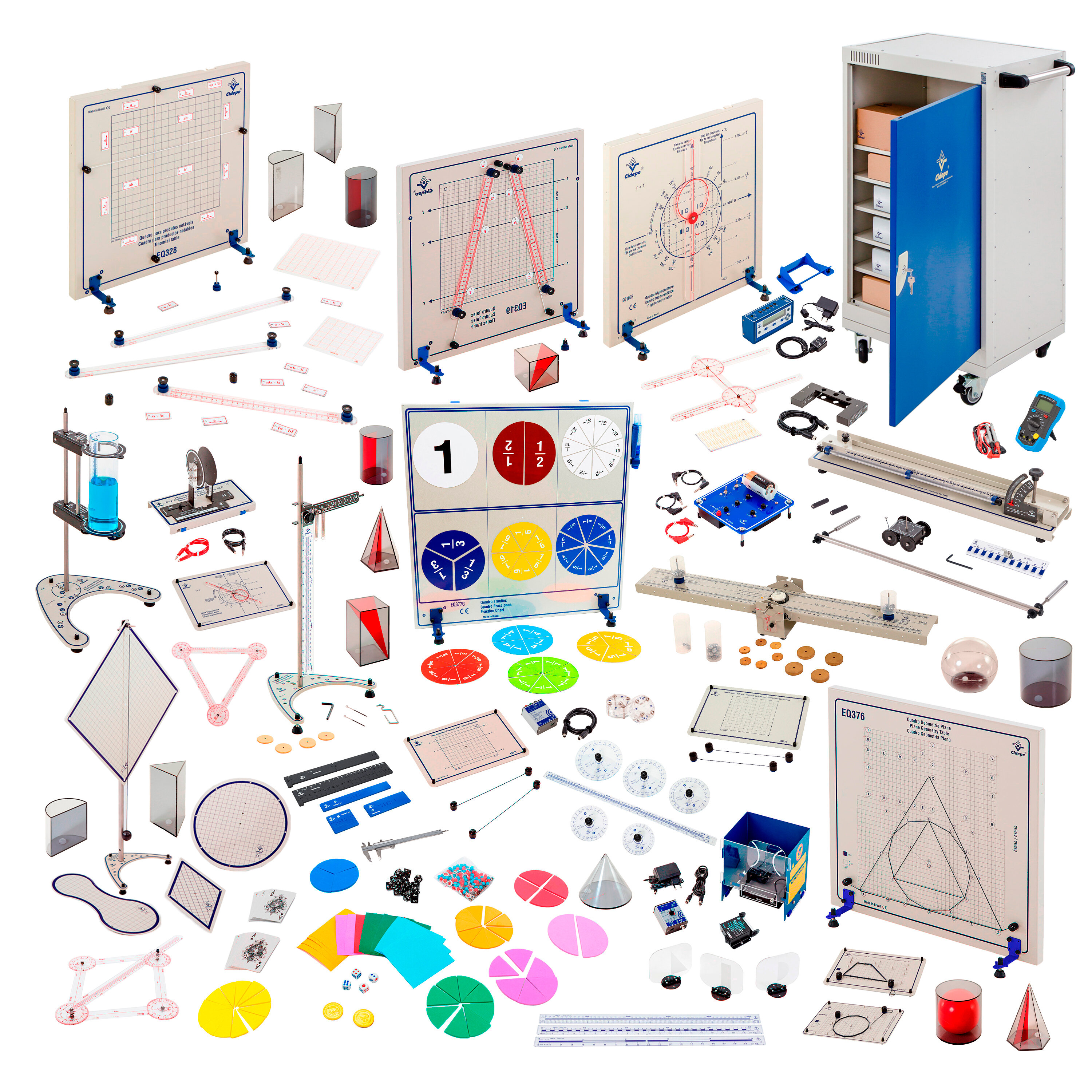
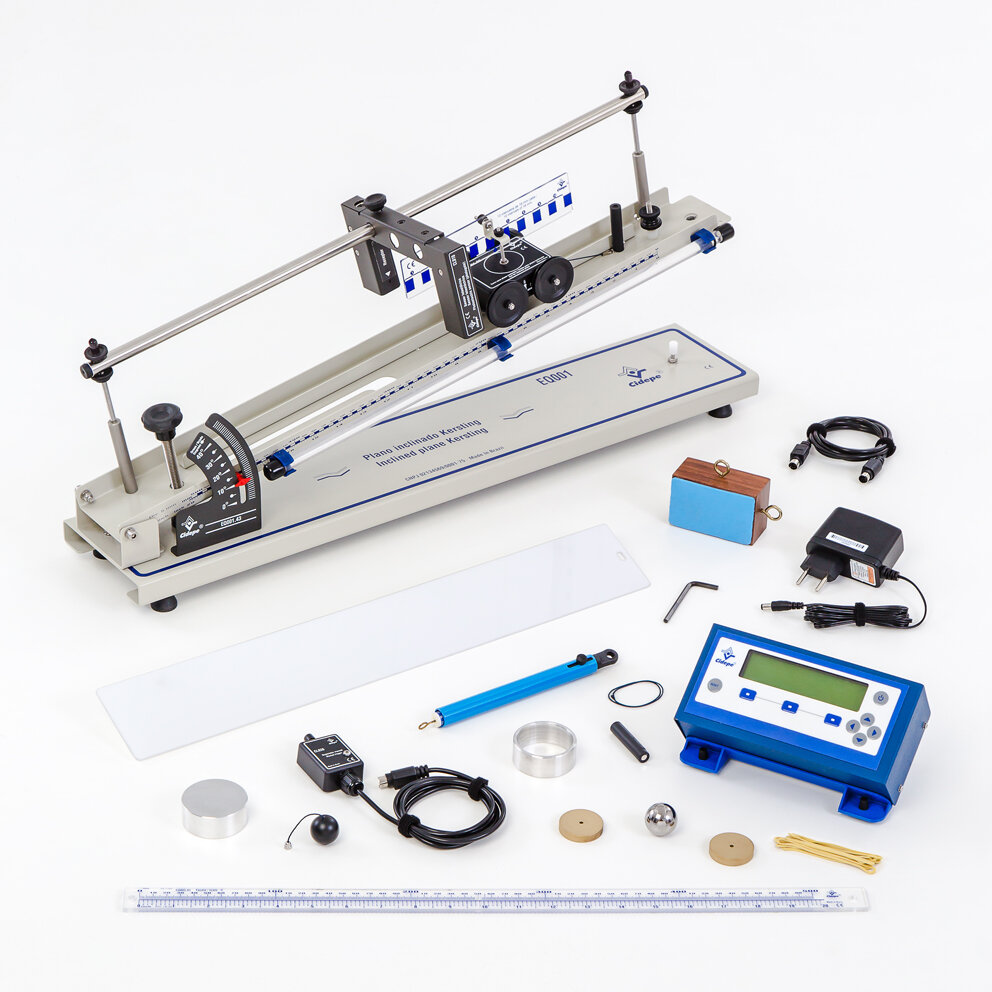
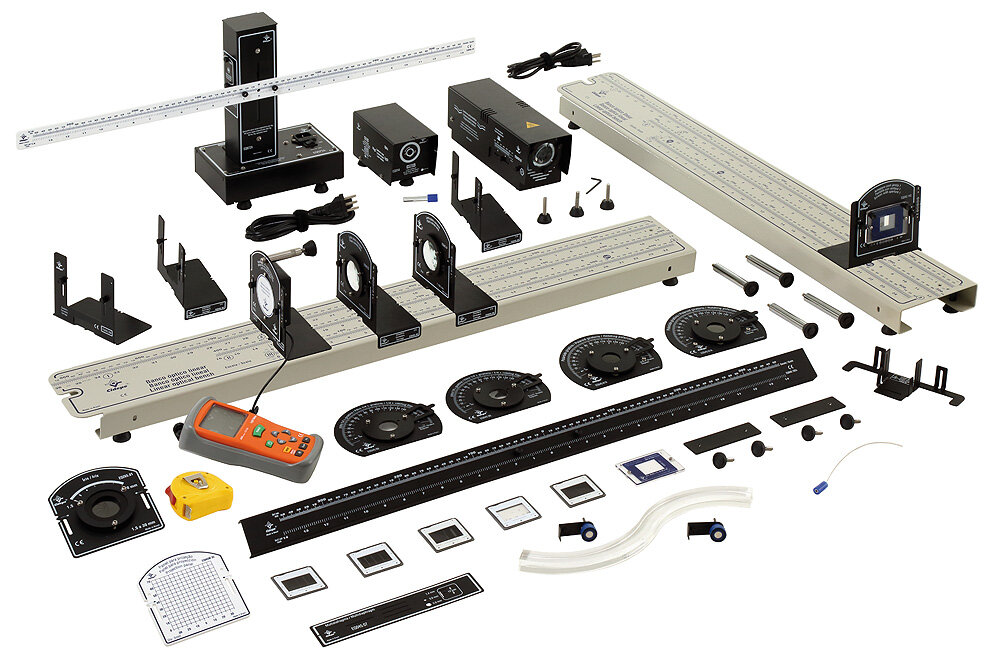
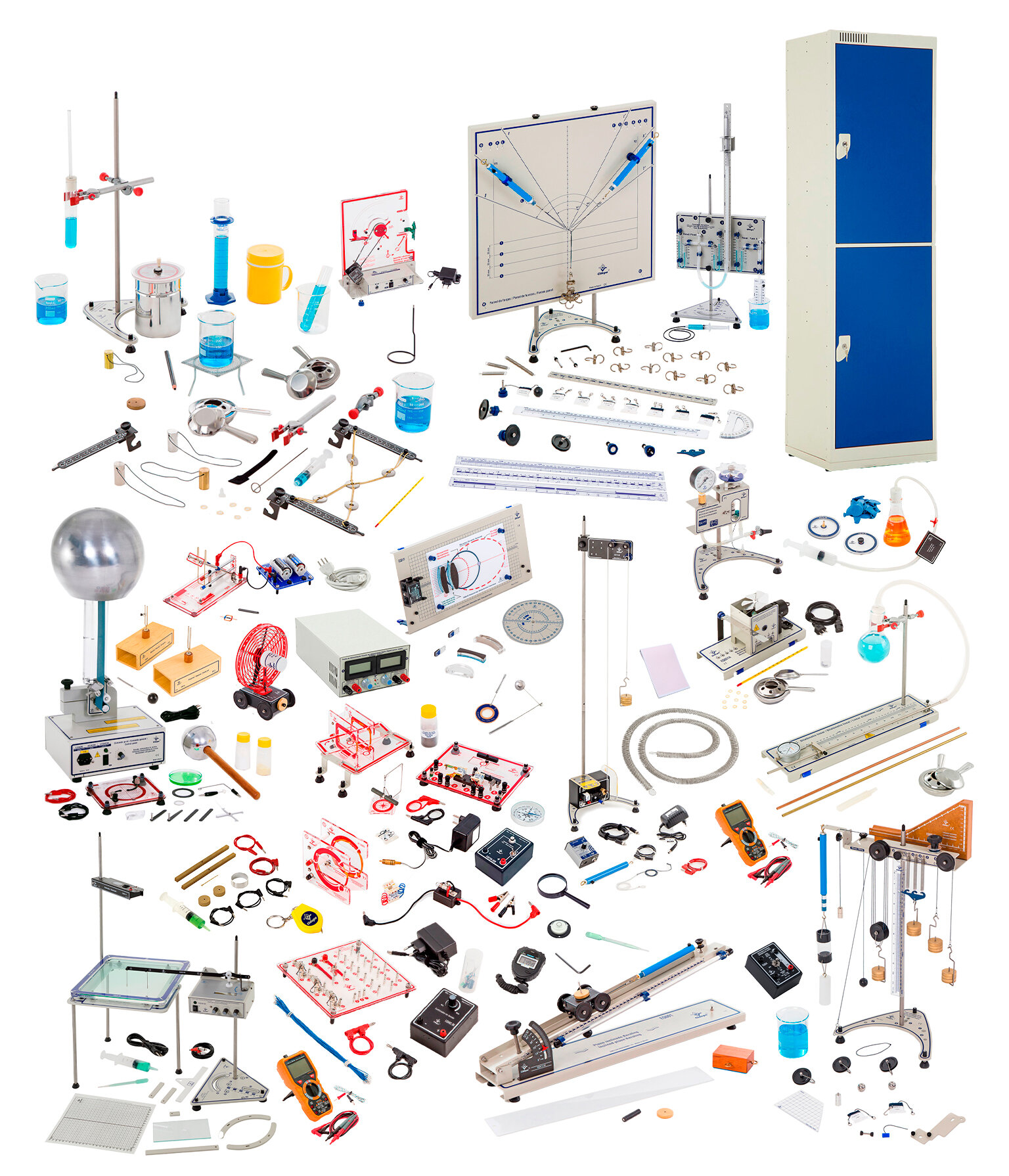
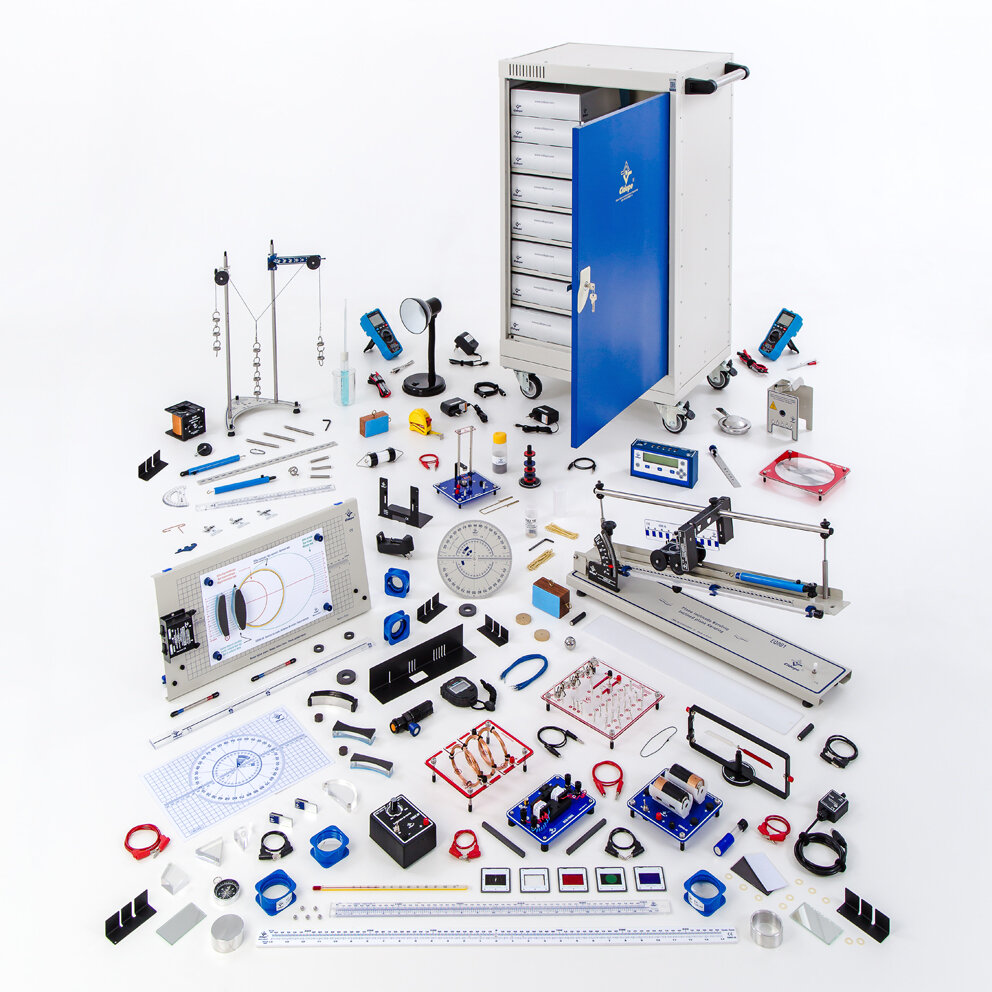
Mobile physics laboratory for high school students
Code: EQ321F2

Function
Intended for experimental study, a natural science laboratory, and conducting natural science experiments on: mechanics, one-dimensional motion, scalar kinematics, reference frame, position, motion and trajectory, moving object, trajectory and displacement, difference between displacement and distance traveled, reference frame, Cartesian reference system, scalar quantity, vector quantity, uniform rectilinear motion and its characteristics, how to level the base of a long rail with an incline at the head, what is uniform rectilinear motion (MRU), measuring distances and time, completing tables and constructing graphs, the slope of the graph and the speed of the moving object, time function of MRU, predicting the future position of a moving object in MRU, calculating the speed of the moving object between two positions it occupied, force, mass and weight, tables, graphs and functions, elastic deformation and plastic deformation, Hooke's law, association of helical springs in series and in parallel, restoring force, work and energy in a mass and helical spring system, simple harmonic motion (SHM), buoyancy, vector. Composition and decomposition of coplanar forces, resultant force, equilibrium conditions of a material point and a rigid body, moment of a force, Varignon's theorem, simple machines, pulleys, mechanical advantage, simple pendulum, force, mass and weight, tables, graphs and functions, temporary deformation (elastic deformation), permanent deformation (plastic deformation), heat, heat transfer, conduction, convection and radiation, influence of color on thermal insulation, energy transformations, volumetric expansion, heat, temperature, electricity, series and parallel connection of lamps, fuse, Joule effect, potential difference, DC circuit, electric current, voltmeter, ammeter, Ohm's law, non-ohmic resistor, series and parallel connection of resistors, equivalent resistance, color code, electrical resistance, series and parallel connection of capacitors, equivalent capacitor, charging and discharging of a capacitor, RC circuit, Kirchhoff's loop laws, Kirchhoff's loop laws, diode, mixed circuits, electrical power, light and optics, principles From geometric optics, transparent, homogeneous, and isotropic media, the three principles of geometric optics, reflection in a mirror, angle of reflection, first and second laws of reflection, angle of rotation of the reflected ray, image formed in a plane mirror and its characteristics, number of images formed between two plane mirrors at an angle to each other, observing and filling in a data table, equation for the number of images between plane mirrors, reflection in concave and convex spherical mirrors, spherical mirror, focus and focal length of the concave mirror, principal axis in spherical mirrors, three principal rays in the concave spherical mirror, caustic in a concave spherical mirror, principal rays of the convex mirror, focus and focal length of the convex mirror, refraction of light and its laws, lenses and diopters, incident ray and refracted ray, angle of incidence and angle of refraction, first law of refraction, second law of refraction, refraction of light when passing from a less dense medium to a denser one, refractive index of acrylic, critical angle, limiting angle of Refraction, total reflection, total reflection, Gauss's law, relationship between the object, lens and image, Gaussian reference frame, abscissas of the object and the image, ordinates of the object and the image, Gauss's equation or conjugate points equation, transverse linear magnification (magnification), classification of the image formed by the lens as a function of the sign of the linear magnification, vision defects, etc.
Quote product

Main experiments
- Reference frame, position, movement and trajectory. 1032.001
- What are the characteristics of uniform rectilinear motion (MRU)? 1032.005B1JM
- The meeting of two objects in uniform rectilinear motion (MRU) with opposite directions. 1032.005C1JM
- Uniformly accelerated motion (MRUV) and its characteristics, displacement in one dimension. 1032.006_DJM
- Frictional forces and Newton's first law of motion. 1032.046
- Determining the coefficients of static, kinetic, and sliding friction on an inclined plane. 1032.048
- Hooke's law in a helical spring. 1032.052B_1
- Association of helical springs in series. 1032.053B_1
- Parallel helical spring system. 1032.053C_1
- The equilibrium conditions of a body on an inclined plane. 1032.043
- The driving force, the resisting force, and the mechanical advantage of the inclined plane, a simple machine. 1032.034
- Mass, weight and determination of the local g value. 1032.039_1
- The simple machine called a fixed pulley. 1032.026_1
- A simple machine called a movable pulley. 1032.026_2
- The composition and decomposition of concurrent coplanar forces. 1032.040F_1
- The conditions for rigid body equilibrium, Varignon's theorem. 1032.035F_1
- Work and energy exchange in an oscillating mass-spring system, conservation of mechanical energy. 1032.056B_1
- Determining the translational kinetic energy and potential energy of a sphere rolling down a ramp. 1032.072A4JM
- Conservation of mechanical energy, moment of inertia. 1032.072A1JM
- The hydrostatic force buoyancy, a quantity with direction, sense, and magnitude. 1042.028D
- Archimedes' principle, buoyancy and its relationship to the volume and density of the displaced liquid 1042.032D
- Archimedes' principle. 1042.032B
- Determining the density of an irregular solid through buoyancy. 1042.032D5
- The laws of the simple pendulum. 1032.013_3
- The dynamic determination of the spring constant in a mass-spring, rod-type oscillator. 1032.012_4JM
- The burning of a candle produces light and heat. 0001.235
- Conduction, a means of heat propagation, means of transmission, heat transfer. 1052.024D
- Convection, a means of heat propagation, means of heat transmission, heat transfer. 1052.024D1
- Irradiation, a means of heat propagation, means of heat transmission, heat transfer. 1052.024D2
- The influence of color on thermal insulation. 1052.024D3
- Some energy transformations: electrical, luminous, thermal, and mechanical. 1052.026D
- The thermoscope. 1052.004B_1
- Light, the properties of rectilinear propagation and the independence of rays. 1062.003E1B
- The principles of geometric optics, white light. 1062.004A2
- The reflection of light in a plane mirror and the laws of reflection. 1062.003E2B
- The laws of reflection in a plane mirror. 1062.004C2
- An application of multiple reflections between plane mirrors. 1062.003E3B
- Reflection in concave and convex spherical mirrors. 1062.003E4B
- The refraction of light and its laws, the diopters. 1062.003E5B
- Spherical lenses and their main characteristics. 1062.003E6B
- Vision defects, correction of ametropia, hyperopia and myopia, with lenses. 1062.003E7B
- Refraction in a 90-degree optical prism. 1062.003E8B
- The image formed in a plane mirror and its characteristics. 1062.004D
- The number of images formed between two plane mirrors at an angle to each other. 1062.004E
- Gauss's law, the relationship between the object, lens, and image. 1062.004L2
- Refraction and dispersion of light; decomposition of light in a 60-degree optical prism. 1062.004H3
- Observing the phenomenon of light polarization, Malus's law. 1062.004H5
- Determining the average wavelength of the colors in the continuous spectrum of white light. 1062.004H6
- The composition of colors derived by luminous superposition. 1062.004H7
- A magnifying glass, an optical instrument. 1062.004H8A
- The optical microscope, an optical instrument. 1062.004H8B
- An astronomical telescope, an optical instrument. 1062.004H8C
- Series connection of resistors, determining the equivalent resistor. 1082.044F2
- Parallel connection of resistors, determining the equivalent resistor. 1082.044F3
- Series and parallel lamp connections. 1082.044C2
- The association of capacitors in series and parallel. 1082.044J2
- The function of a fuse, the Joule effect. 1082.044D2
- The measurement of the potential difference (voltage) between two points in a DC circuit. 1082.044G2
- The measurement of electric current intensity in different sections of a DC circuit. 1082.044H2
- Ohm's first law, a relationship that links the three main electrical quantities. 1082.044E2
- Determining the electrical power of components in a mixed electrical circuit. 1082.092A_7
- Identifying a resistor that does not obey Ohm's law, a non-ohmic resistor. 1082.044I2
- The electrical resistance offered by a diode and its polarization. 1082.044L2
- Kirchhoff's loop law. 1082.044M2
- Kirchhoff's knot law. 1082.044M3
- Charging and discharging a capacitor, series RC circuit. 1082.067B
- Observing the magnetic field lines around different magnets. 1082.122B
- Observing the magnetic field lines around magnets and objects placed in their magnetic field. 1082.116A
- The magnetic field lines around a magnet and one of the ways to magnetize a ferromagnetic object. 1082.120D
- The levitation effect with ring magnets. 1082.123A
- Oersted's experiment and electromagnetism. 1082.127B
- Magnetic induction inside a loop and a solenoid carrying an electric current. 1082.173
- The direct current electric motor, an application of the laws of electromagnetism. 1082.154
- Faraday's law, Lenz's law, Faraday-Lenz-Neumann law, electromagnetic induction, electromagnetic phenomena. 1082.128A_1
- Magnetic balance and the force that drives it. 1082.138
- The electrical voltage transformer. 1082.176_62
- Determining the threshold voltage, Planck constant, and characteristic curve of a green LED. 1082.181D
- Determining the threshold voltage, Planck constant, and characteristic curve of a red LED. 1082.181E