
 Português
 English
 Español
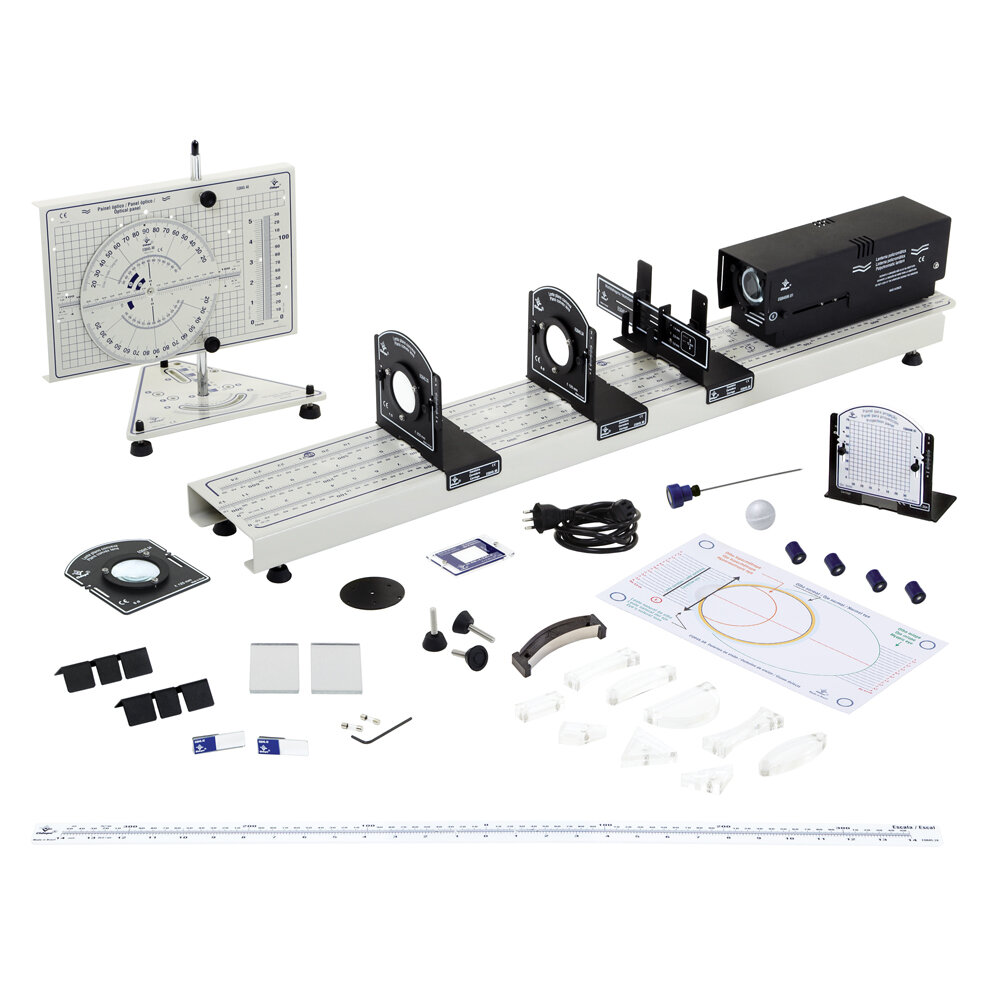
Advanced optical bench IV
Code: EQ262D

Function
Intended for experimental study, physics laboratory work, and conducting physics experiments on: Light and optics. The principles of geometric optics. Transparent and translucent media to light. Opaque, homogeneous, and isotropic media. The principles of geometric optics. Simulation of a solar eclipse and identification of umbra and penumbra. Partial solar and total lunar eclipses. The laws of reflection in a plane mirror. The angle of incidence, the angle of reflection, and the angle of rotation of the reflected ray. The image formed in a plane mirror and its characteristics. The expression that allows calculating the number of images between two plane mirrors at an angle to each other. Reflection in concave and convex spherical mirrors. Vertex, focus, real focus, focal length, and center of curvature of a concave mirror. Principal axis, secondary axes, aperture angle, and real aperture of a spherical mirror. The three principal rays of a concave mirror, concave mirrored diopter. Caustics in a concave spherical mirror. Convex mirror, convex mirrored diopter. The focus and focal length of a convex spherical mirror. Characteristics of the three principal rays of a convex spherical mirror. The refraction of light and its laws, diopters. What is a diopter? The point of incidence, the incident ray, and the refracted ray. The angle of incidence and the angle of refraction. The laws of refraction. The critical angle, the limiting angle of refraction, and total reflection, optical fibers. Brewster's angle. Brewster's law. The refraction and dispersion of light in optical prisms. The dispersion of light, the decomposition of light, in an optical prism. Spherical lenses and their main characteristics. What is a lens? The characteristic of the light ray contained in the optical axis of a lens. Identifying the focus and measuring the focal length. The characteristic of the incident ray passing through the focus and the characteristic of the incident ray parallel to the optical axis of a lens. The three principal rays of diverging lenses, negative lenses. Virtual focus and focal length of a diverging lens. The lens and its vergence, convergence, or diopter. Building a magnifying glass. Building a compound optical microscope. The conjugate image. Building a terrestrial telescope. Light and physical optics. Modern physics. Wave physics. Measuring the wavelength of colors in the continuous light spectrum. Diffraction and Huygens' principle. Young's double-slit experiment and the wavelength of light. Gauss's law, the relationship between the object, lens, and image. The Gaussian reference frame. The conjugate points function, Gauss's equation. Transverse linear magnification, enlargement. Measuring the wavelength of the spectral lines of Hydrogen. Maxima of order 0 and 1. What is the lattice constant of a diffraction grating? The diffraction angle. Constructive interference. Measuring the wavelength of the spectral lines of Helium, Mercury, Nitrogen, and Oxygen. Vision defects, correction of hyperopia and myopia with lenses. Light, polarization of light and the Polaroid. Plane-polarized light. Construction of the optical instrument magnifying glass, the optical instrument compound microscope and the terrestrial telescope. Malus's law. Diffraction of light by holes and slits. Diffraction and Huygens' principle. Using a hole of known diameter to determine the wavelength of a laser. The diffraction angle. Bessel's function and the equation to find the wavelength of a laser. Diffraction of laser light by a diffraction grating with a known grating constant. What Huygens' principle states. The luminous flux density on a surface. The difference between luminous flux and radiant flux. The illuminance of a surface, surface luminous flux density. The lumen and the lux. The relationship between illuminance, distance between the light source and the illuminated surface. Measuring the illuminance over the illuminated area, etc.
Quote product

Main experiments
- The principles of geometric optics. 1062.004A
- Simulation of a solar eclipse and identification of the umbra and penumbra. 1062.004B
- The laws of reflection in a plane mirror. 1062.004C
- The image formed in a plane mirror and its characteristics. 1062.004D
- The number of images formed between two plane mirrors at an angle to each other. 1062.004E
- An application of multiple reflections between plane mirrors. 1062.004F
- Reflection in concave and convex spherical mirrors. 1062.004G
- The refraction of light and its laws, the diopters. 1062.004H
- Refraction and dispersion of light in optical prisms. 1062.004I
- Spherical lenses and their main characteristics. 1062.004J
- The measurement of the average wavelength of the colors in the continuous spectrum of light, diffraction. 1062.004Q
- Gauss's law, the relationship between the object, the lens, and the image. 1062.004L
- Vision defects, correction of hyperopia and myopia with lenses. 1062.002K_2
- Comparing the polarization of laser light with the polarization of polychromatic light. 1062.003N
- The construction of the optical instrument magnifying glass. 1062.004P1
- The construction of the compound microscope optical instrument. 1062.004P2
- The construction of the terrestrial telescope optical instrument. 1062.004P3
- Malus's law, lux meter. 1062.005
- Diffraction of light through holes and slits. 1062.003D
- Diffraction of light from a laser with a diffraction grating of lattice constant 8.33 x 10⁻¹⁰⁶².00⁴D¹ 1062.004D1
- Diffraction of laser light by a diffraction grating with a grating constant of 1.00 x 10⁻¹⁰⁶².00³M¹ 1062.003M1
- The luminous flux density on a surface. 1062.041A
- The illumination over the illuminated area. 1062.042A
- Measuring the illuminance over the illuminated area, using a lux meter. 1062.044A
- Total reflection and optical fibers. 1062.004S12
- Measuring the wavelength of the spectral lines of Hydrogen. 1062.004T2_H
- Measuring the wavelength of Mercury's spectral lines. 1062.004T2_HG
- Measuring the wavelength of the spectral lines of Helium. 1062.004T2_HE
- Measuring the wavelength of the spectral lines of Nitrogen. 1062.004T2_N
- Measuring the wavelength of the spectral lines of Oxygen. 1062.004T2_O
- The construction of some optical instruments. 1062.004P