
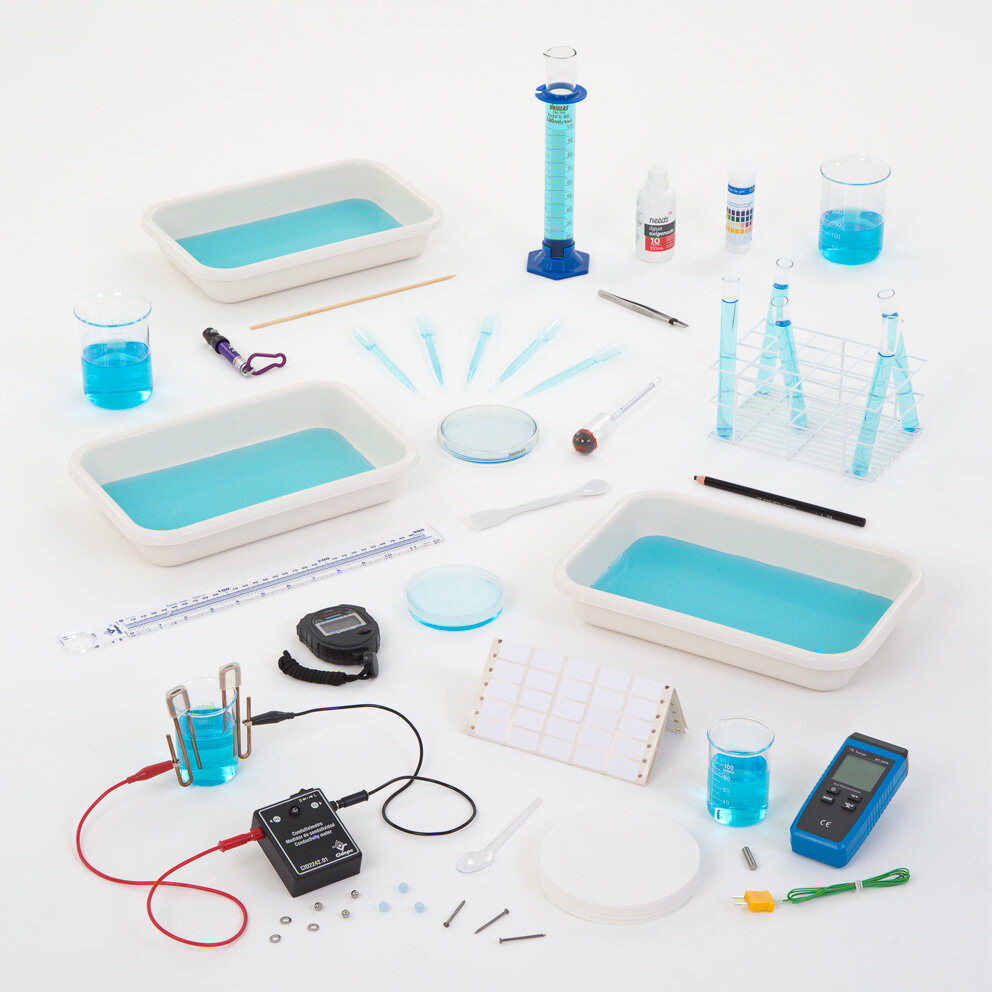
Intended for experimental study, science or chemistry laboratory, and conducting experiments on: Chemistry. Thermal sensation and temperature. Thermal sensations in water at room temperature and heated water. Thermal sensations in water at room temperature, ice water, and heated water. Comparing the thermal sensation with the temperature indicated by a thermometer. Producing oxygen through a chemical reaction. The hydrogen peroxide test. The ember test. Separating objects using a magnet. Magnetic force and the force of gravity. How to test the pH of different substances? How to determine the density of a liquid using an aerometer? Specific mass. Relative density. Precautions when measuring density with aerometers. How to separate homogeneous mixtures using paper chromatography? Adsorption is a surface phenomenon. How to relate the properties of substances through electrical conductivity? Behavior of the passage of a light beam through mixtures, Tyndall effect. Mixtures. The solution. The colloid. The aggregate. The solute and the solvent. What is meant by the Tyndall effect, etc.
Natural sciences. General chemistry. Separation of homogeneous and heterogeneous mixtures. Sensation of heat and temperature. Properties of materials. Electrical conductivity. Chemical reactions. pH of substances.