
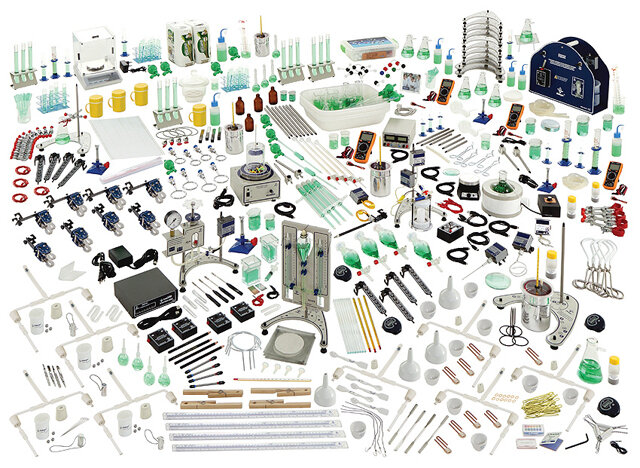
Intended for experimental study, chemistry laboratory work, and conducting chemistry experiments on: General guidelines for activities in a chemistry laboratory. Laboratory reports and notebooks. Some solutions used in experimental activities. Metrology. Comparing different volume measurement scales. Volume measurements with different instruments and their measurement uncertainties. Determining temperatures at different points in a Bunsen burner flame. Properties and transformations of matter. How to identify homogeneous and heterogeneous systems? How to determine the density of a liquid using a pycnometer? How to determine the density of a liquid using a hydrometer? How to determine the density of a solid? The solidification of water. The melting of ice. Lavoisier's and Proust's laws in a reaction chamber. Separation of mixtures. How to separate heterogeneous mixtures through simple filtration? How to separate heterogeneous mixtures through magnetic separation? Vacuum filtration. How to separate heterogeneous mixtures through decantation? How to separate homogeneous mixtures using paper chromatography? Fractional distillation. Chemical bonds. How to relate the properties of substances through electrical conductivity? How to relate substances through solubility in polar and nonpolar solvents? Chemical reactions. How to identify the occurrence of a chemical reaction? How does the decomposition or analysis reaction of sodium carbonate occur? How does the synthesis reaction of ammonium chloride occur? How does the hydrogen displacement reaction, single replacement, occur? How does a double replacement reaction occur? How does an oxidation-reduction reaction occur? Inorganic functions. How do acids and bases behave in relation to different indicators? How to analyze the different chemical properties of acids? How to identify the character of an oxide and the character of an acidic oxide? How to obtain a basic oxide? How to obtain salts? Chemical equilibrium. Determination of pH and limitations of indicator paper. Titrimetry. The concentration of acid in a fruit. Thermochemistry. The water equivalent and the heat capacity of a calorimeter. Determining the specific heat capacity of a solid. Endothermic reaction of copper sulfate with water. Exothermic chemical reaction of copper nitrate. Heat of neutralization. Electrolysis. Electrochemistry, the Daniell cell. Electrolytes, second-class conductors. The decomposition of water through electrolysis. Chemical kinetics. The factors of concentration, temperature, and catalyst. Study of gases and their transformations. Isothermal transformation and Boyle-Mariotte's law. Influence of temperature on the atomic and molecular motion of a gas. Chemical solutions. Concentration of solutions, common and ppm, molar, molarity, normal, normality, titer, percentage by volume. Carbon and its compounds. Construction of three-dimensional organic structures. Identifying the presence of carbon through the flame, from the burning of the carbohydrate sucrose, sugar. Identifying the presence of hydrogen through anhydrous copper sulfate. Identifying the presence of nitrogen in urea through ammonia gas. Identifying the presence of halogens through the formation of a salt using a flame. Identifying the presence of oxygen by the color change in organic compounds. Identifying the presence of sulfur in a strand of hair. Organic functions. Hydrocarbons: obtaining an alkane using Dumas' method; obtaining an alkene using Bayer's test; obtaining an alkyne using Wöhler's method; identifying an alkyne. Aromatic hydrocarbons: solubility. Aromatic hydrocarbons: combustion. Aromatic hydrocarbons: alkylation reaction. Alcohols: water absorption and color change. Alcohols: oxidation reaction.
Chemistry, chemical equilibrium, thermochemistry, kinetics, electrolysis, solutions, carbon and its compounds, organic functions.