
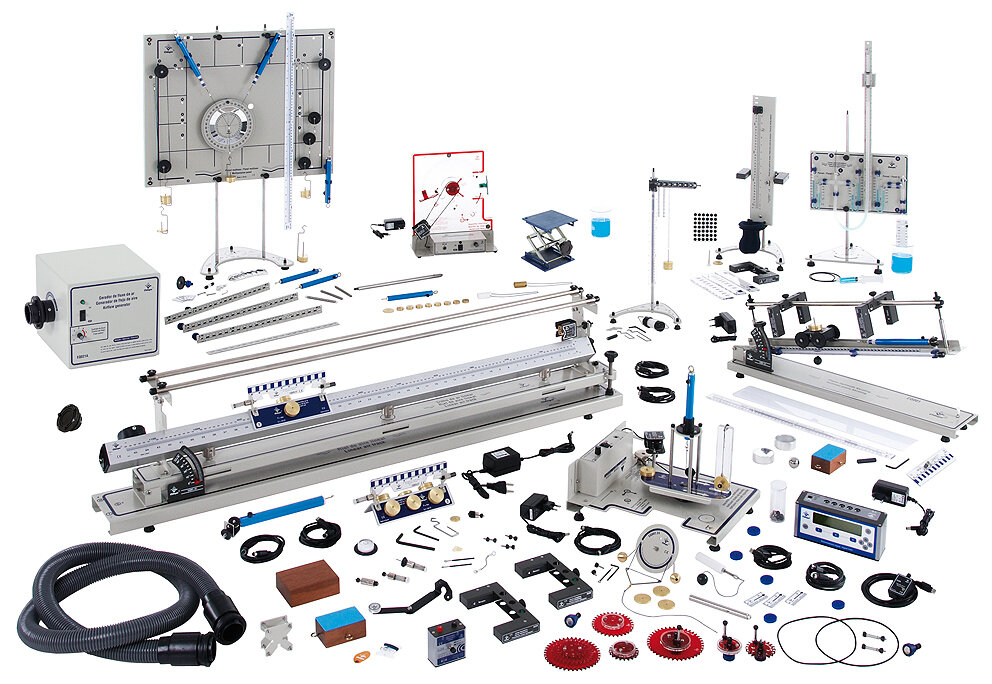
Intended for experimental study, physics laboratory work, and conducting physics experiments on: mechanics of solids and fluids. Mechanics of solids. Kinematics. Reference frame, position, motion, and trajectory. Trajectory and displacement. The difference between displacement and distance traveled. The Cartesian reference system. Scalar quantity. Vector quantity. What are the characteristics of uniform rectilinear motion (MRU)? Progressive MRU and retrograde MRU. Uniformly accelerated rectilinear motion (MRUV) and its characteristics. Acceleration and velocity variation. The relativity of motion according to the reference frame. Pure rotational motion and pure translational motion. Uniform circumferential motion. Frequency and its relation to period. The transmission ratio. Building a reducer with pulleys and a belt. The driving pulley and the driven pulley. The torque gain between pulleys coupled by a belt. The driving gear and the driven gear in an amplifier. The torque gain in a gear reduction system. Free fall motion with a test body in 10 equal intervals. The time function of uniformly accelerated free fall motion. Statics. Diagram of coplanar forces. The condition for a material body to be in equilibrium. The driving force, the resisting force, the inclined plane as a simple machine. The driving force depends on the slope of the ramp. The composition of concurrent coplanar forces, force, vector, and the parallelogram rule. Remembering orthogonal coplanar vectors. Comparing the magnitude of the resultant with that of the equilibrant. The equilibrium conditions of a rigid body, Varignon's theorem. The first-class lever, the second-class lever, and the third-class lever. Dynamics. Determining the gravitational acceleration at the location of the experiment. The helical spring and Hooke's law. Dynamic determination of the elastic constant of a spring. Friction forces and Newton's first law of motion. The determination of the coefficients of static, kinetic, and sliding friction. A fixed pulley, a movable pulley, an exponential pulley system, and a parallel block and tackle. A freight elevator with pulleys and a platform. The diagram of the forces acting on the crossbar. The fundamental law of dynamics, Newton's second law. Centripetal force as a function of mass, tangential velocity, and radius. Centripetal force as a function of angular velocity. The direct dependence of centripetal force on the square of the angular velocity. Centripetal force as a function of frequency. Centripetal force as a function of mass. Centripetal force as a function of radius. The frequency, period, and critical angular velocity of a conical pendulum. Conservation of mechanical energy. Work and energy in a mass-spring system. Energy exchanges occurring in an oscillating mass-spring system. The principle of conservation of energy and kinetic energy. Conservation of mechanical energy, moment of inertia. The moment of inertia. The rotational kinetic energies of cylinders at points of interest. Comparing initial mechanical energy with final mechanical energy. Coefficient of restitution, momentum, and kinetic energy in an inelastic collision. Mechanical collisions, momentum, and kinetic energy. Coefficient of restitution, momentum, and kinetic energy in an elastic collision. Conservation of angular momentum. Rotational inertia. Centrifugal force, a "different" force. The principle of conservation of mechanical energy in a falling cylinder. Hydrostatics. Archimedes' principle. Determining the density of a solid through buoyancy. Absolute density, or specific mass. Specific weight. Determining the density of a solid test specimen. Pressure at a point in a liquid in equilibrium, Stevin's theorem, fundamental law of hydrostatics. Pascal's principle. Kepler's laws for planetary motion, etc.
Physics, solid mechanics, kinematics, dynamics, statics, conservation of mechanical energy, fluid mechanics, hydrostatics, gravitation.