
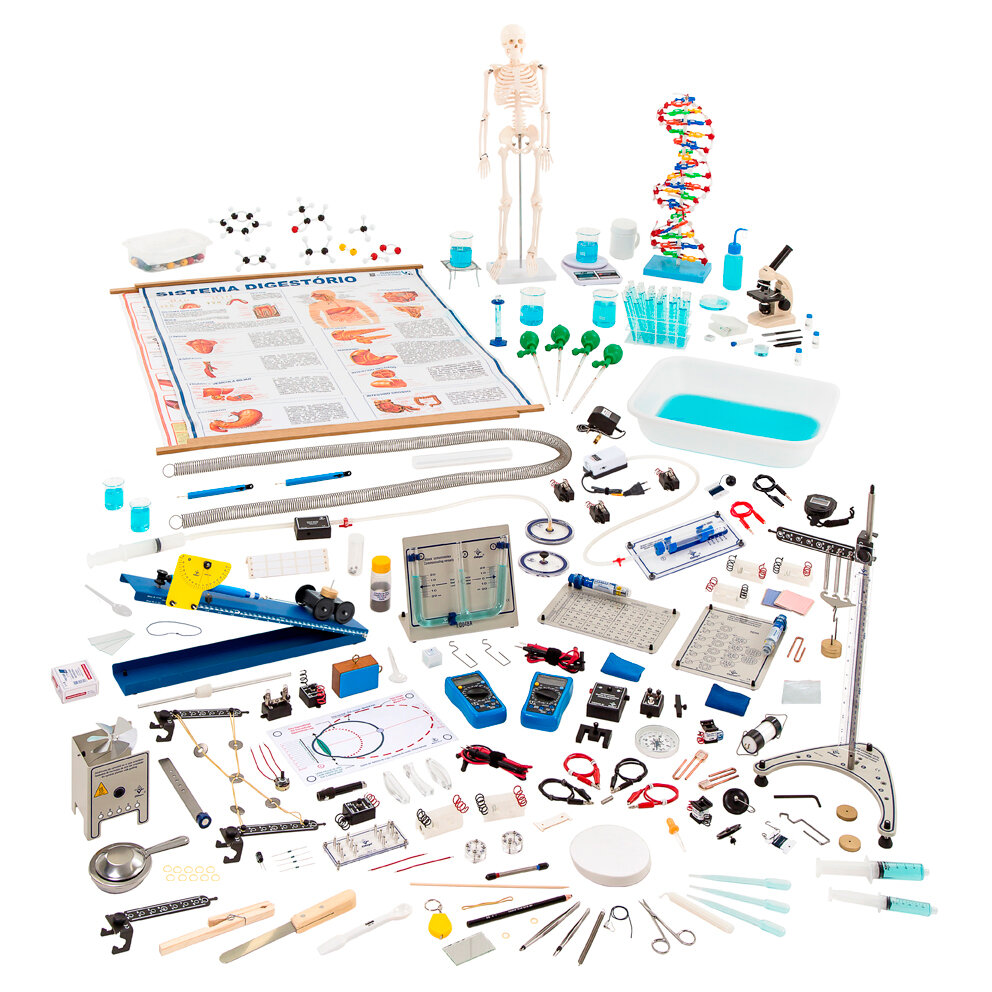
Intended for experimental study, this is a science laboratory for natural sciences, physics, chemistry, and biology, for conducting experiments on: Matter and energy. The melting of ice, the change of state of water from solid to liquid. The general properties of matter. The specific properties of matter. The burning of a candle produces light and heat. A simple machine called a fixed pulley. Force applied to a spring and the resulting elongation. The difference between force and pressure. The Magdeburg hemispheres experiment and atmospheric pressure. What is meant by Magdeburg hemispheres. Reducing the internal pressure of discs. Balancing the internal pressure of discs with atmospheric pressure. The free surfaces of a liquid within communicating vessels. The thermoscope. The difference between a thermoscope and a thermometer. The difference between heat and temperature. The physical states of water. The solidification of water, obtaining colored ice. Boiling and condensation of water. The means of heat propagation. Kinematics. Reference frame, position, motion, and trajectory. A simple machine called a movable pulley. Dynamics. Friction forces and Newton's first law of motion. The helical spring and Hooke's law. Association of helical springs in series. Determination of the spring constant of helical springs in series. Conservation of Energy. Work and energy in a system of mass and oscillating helical spring, conservation of mechanical energy. Statics. Experimental determination of the mechanical advantage of an inclined plane. Equilibrium of a body on an inclined plane. Hydrostatics. Buoyancy, a vertical force oriented upwards. Electricity. Electrical conductors and electrical insulators. Series, opposition, and parallel connections between batteries. Series and parallel lamp connections. Ohm's law. Series, parallel, and mixed resistor connections. Kirchhoff's loop laws and node law. The potentiometer, a variable resistor. Measurements in mixed circuits, electrical power, direct current. The series RC circuit, direct current. Magnetism. Permanent magnets, temporary magnets, and the electromagnet. Electromagnetism. The electrical voltage transformer. Wave phenomena. Main characteristics of waves in a spring. The propagation speed of a pulse in a spring. Mechanical waves. Remembering what a wave pulse is. The phenomenon of reflection and interference in a transverse wave in a spring and the standing wave. Chemistry. Properties of materials. How to determine the density of a liquid using a pycnometer? Periodic table. The electronic distribution of chemical elements. The kinetic behavior of gases. Influence of temperature on the atomic and molecular movement of a gas. Separation of mixtures. How to separate heterogeneous mixtures using magnetic separation? How to separate homogeneous mixtures using paper chromatography? Chromatography. Adsorption: a surface phenomenon. Chemical bonds. How to relate the properties of substances through electrical conductivity? Chemical reactions. How does a displacement reaction occur? How does a double displacement reaction occur? Inorganic functions. How to identify the character of an acidic oxide? How do acids and bases behave in relation to different indicators? Organic chemistry. Construction of three-dimensional organic structures. Alcohol, water absorption. Biology. Are all circulatory systems the same? How to use a biological microscope? Genetics. Are we all the same? What is the probability? The AND rule and the OR rule in genetics. Genetic crosses, using a Punnett square. Vision defects, correction of hyperopia and myopia with lenses, with a laser flashlight, a beam, etc.
Natural sciences, physics, Earth and universe, mechanics of solids, statics, dynamics, conservation of energy, wave phenomena, hydrostatics, wave phenomena, geometric optics, reflection and refraction of light, lenses, population biology, Mendelian genetics, heredity. General chemistry, properties and characteristics of atoms, periodic table, study of the behavior of gases.