
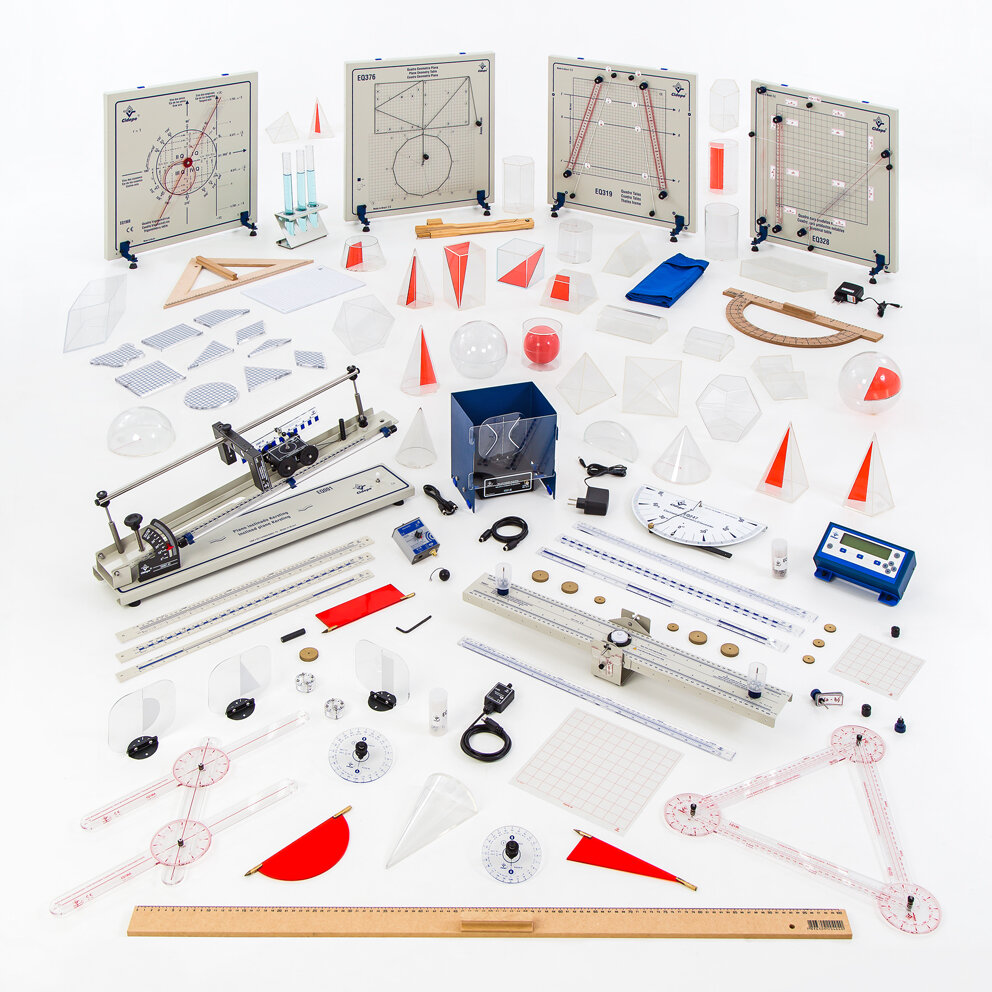
Intended for experimental study, this mathematics laboratory is designed for conducting experiments on: Mathematics. Metrology. Significant figures and uncertainties. Different volume measurement scales and their errors. Algebra. First-degree equations with one unknown and the additive and multiplicative principles of equalities. Determining the mass of an object using a balance with equal arms. First-degree inequalities with one unknown and the additive and multiplicative principles of inequalities. Ratio, how to compare by means of division. Proportion and the directly proportional relationship. The inversely proportional relationship. The notable product of the square of the sum of two terms. The notable product of the square of the difference of two terms. Functions. What are the characteristics of the graph of an affine function? Positive angular coefficient. What are the characteristics of the graph of an affine function? Negative angular coefficient. What are the characteristics of a quadratic function? Trigonometry. The degree, the radian, the quadrants and their conversions. The sine in the trigonometric circle, sinusoidal function. Cosine in the trigonometric circle. Tangent in the trigonometric circle. The fundamental trigonometric relation in the trigonometric circle. Angular properties of triangles. Fundamental trigonometric relations of the right triangle. The Pythagorean theorem, a metric relation between the sides of a right triangle. The law of sines and cosines in a right triangle. Measuring the height of a distant object, the clinometer. Probability and statistics. Probability in random events. Plane and metric geometry. How to obtain the number pi in the circumference? The relationships between the angles formed by parallel lines intersected by a transversal line. Thales' Theorem, intersection, ratio and proportion. Using free mathematical software for Thales' Theorem, intersection. Thales' Theorem and similar triangles. Using free mathematical software for Thales' Theorem and similar triangles. How to obtain polygonal lines, quadrilateral and trilateral polygons and their perimeters. How to find the areas of rectangles, squares, and triangles? How to find the areas of parallelograms, trapezoids, and rhombuses? Spatial and metric geometry. Area of a regular hexahedron, the cube. Right and oblique prisms, the area of a right quadrangular prism, parallelepiped. The oblique rectangular prism and the right quadrangular prism, right parallelepiped and its area. Regular right and irregular pyramids, the area of a regular right pentagonal pyramid. The regular right pyramid and the irregular pyramid, the area of a regular right pentagonal pyramid. The area of a right circular cylinder. The sphere and the area of the sphere inscribed in a cylinder. The area of the sphere inscribed in a cylinder. The external, internal, and wall volumes of a hollow cube. Pyramids, the external, internal, and wall volumes of a hollow regular pentagonal pyramid. The external, internal, and wall volumes of a hollow regular pentagonal pyramid. Prisms, the external and wall volumes of a hollow right quadrangular prism. The external, internal, and wall volumes of a hollow right quadrangular prism. Surfaces of revolution. The solid of revolution obtained by rotating a rectangle, the right cylinder. The solid of revolution obtained by rotating a right triangle, the right cone. Sectioning the right cone of revolution with planes of different inclinations, conic sections. The sphere of revolution obtained by rotating a semicircle and the spherical cap. The hyperboloid shell or surface of revolution, rotation of a vertical hyperbola around its central axis, etc.
Mathematics. Logical-mathematical reasoning. Numbers. Quantities and measurements. Metrology. Algebra. Functions. Trigonometry. Probability and statistics. Geometry and measurements. Plane and metric geometry. Spatial and metric geometry. Surfaces of revolution.