
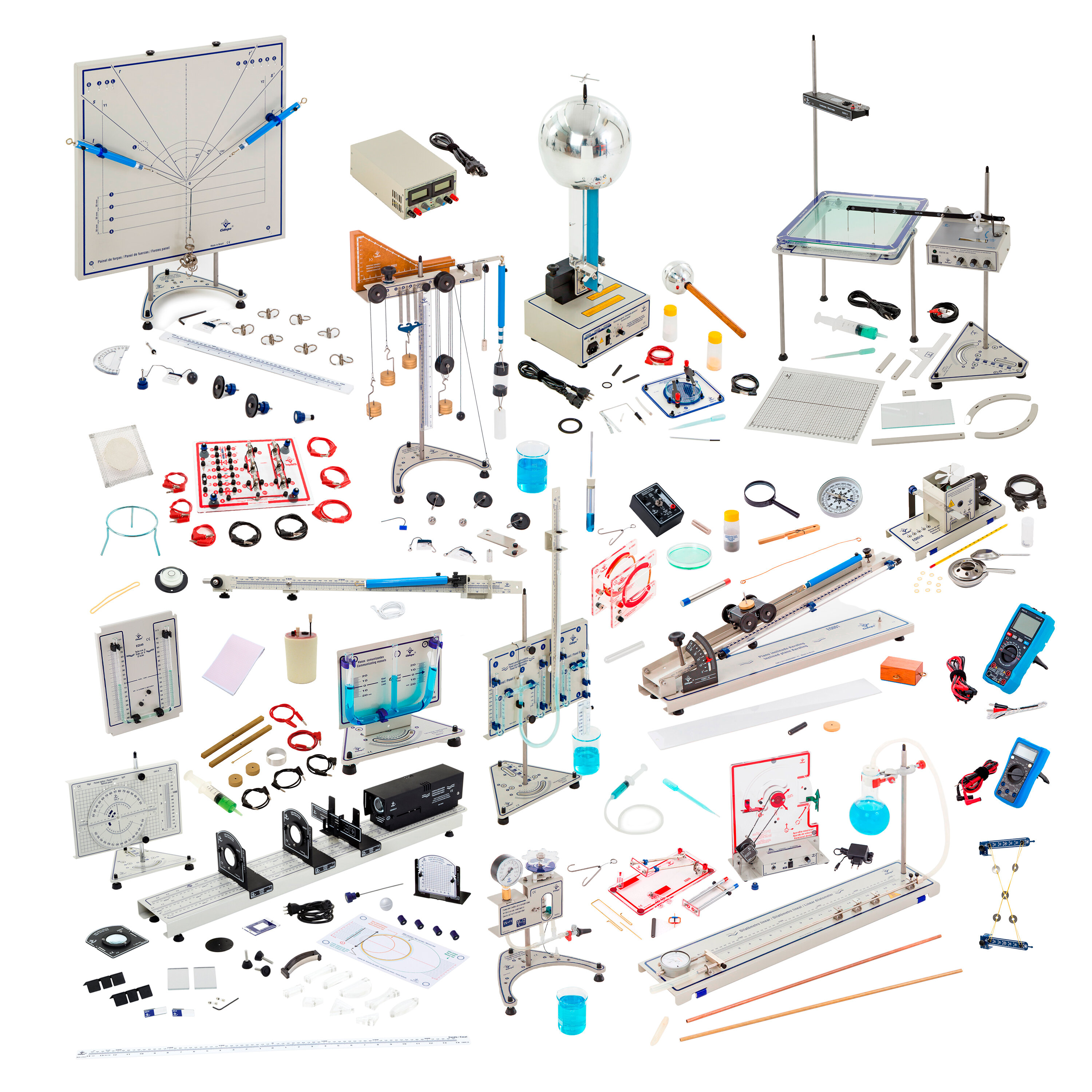
Intended for the study of: Kinematics. A way to determine a person's average reaction time. Reference frame, position, motion, and trajectory. Uniform rectilinear motion (MRU) and its characteristics. Range, uncertainty, and speed in a projectile motion. Reference frame. Uniform circular motion (MCU). Kepler's laws for planetary motion. Statics. The driving force, the resisting force, and the mechanical advantage of an inclined plane. Conditions for stable, unstable, and indifferent static equilibrium. The composition of concurrent coplanar forces. Varignon's theorem. Dynamics. Determining the coefficients of static, kinetic, and sliding friction. Understanding the fixed pulley, the movable pulley, the exponential pulley system, the parallel block and tackle, and simple machines. Elastic hysteresis. Hooke's law. The association of helical springs in series and in parallel. Mechanical work and mechanical energy in a mass-spring system. Hydrostatics. Buoyancy, a quantity with direction, sense, and magnitude. Archimedes' principle. Stevin's theorem. Pascal's principle. The specific weight of a liquid. Thermodynamics, Calorimetry. The thermoscope. Difference between heat and temperature. Energy transformations: electrical to luminous, thermal and mechanical. Conduction, convection and radiation; means of heat propagation; means of heat transmission; heat transfer. The water equivalent and the thermal capacity of a calorimeter. The mechanical equivalent of heat; the electrical equivalent. The specific heat of a solid. The latent heat of fusion of ice. The liquid-solid state change and the solid-liquid state change. Thermal expansion. The variation in the length of copper, brass and steel as a function of the initial length. The determination of the linear expansion coefficient of copper, brass and steel. Thermodynamics. Isothermal transformation; Boyle-Mariotte's law. The influence of color on thermal insulation. Wave motion. The simple pendulum and its laws. Simple harmonic motion in an oscillating system. Transverse mechanical waves in strings. Formation and propagation of two-dimensional waves, propagation speed, reflection, refraction, diffraction, and interference of two-dimensional waves on a liquid surface. Light and optics. Simulation of a solar eclipse and identification of the umbra and penumbra. The laws of reflection, image formed in a plane mirror and its characteristics. Reflection of light in concave and convex spherical mirrors. Refraction of light and its laws, diopters, dispersion of light in optical prisms. Spherical lenses and their main characteristics. Vision defects, correction of hyperopia and myopia with lenses. Gauss's law. Measurement of the average wavelength of colors in the continuous light spectrum. Electricity. Electrification, principles of electrostatics, static electricity. Equipotential surfaces, lines of force and electric field vector between electrodes. Faraday cage and electrostatic shielding. Charge distribution in a conductor. Lighting lamps without contact, "electric fountain," repelling paper strips, lightning rod, hair-raising, tourniquet, "electric wind," electric potential and the amount of charge accumulated in the generator. Configurations of lines of force between electrodes, dielectric strength. Measuring the potential difference and current intensity between points in a circuit, the Joule effect. Series and parallel lamp connections. Characterization of a resistor and its electrical resistance. Ohm's law. Associations of electrical resistances. Identifying a non-ohmic resistor, electrical power. Series and parallel connections of capacitors. The diode and its polarization. Kirchhoff's loop and node laws. Electromagnetism. Lines of force and the magnetic field of a magnet, magnetism. The action of the electromagnetic force on a conductor carrying an electric current. A direct current electric motor, etc.
Physics, mechanics of solids, fluid mechanics, light and optics, thermodynamics, wave phenomena, electricity, electromagnetism, magnetism.