
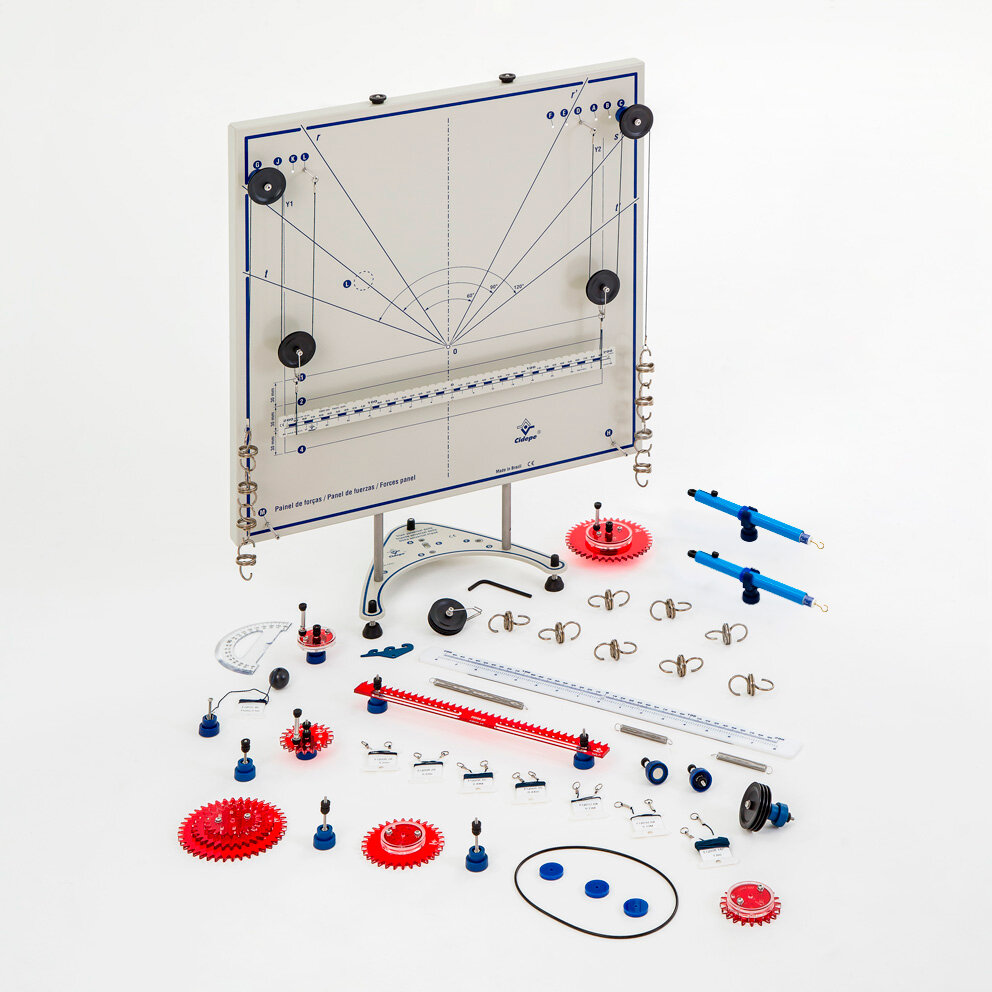
Intended for experimental study, physics laboratory work, and conducting physics experiments on: Kinematics. Assembling a transmission system with belt and pulleys. The transmission ratio between coupled pulleys. The reducer and amplifier with pulleys. Assembling a transmission system with gears. The reducer and amplifier with gears. Assembling a transmission system with belt, pulleys, and gears. Coupling between various gears. Gear trains. Intermediate gears. Gear train. Driving, driven, or intermediate gears. Assembling a transmission system between gear and rack. Statics. Mass, weight, and determination of the local g-value. Measuring weights of masses. Table and graph. The composition of coplanar concurrent forces, with 90° between them. Force and vector. Operations with coplanar and non-parallel vectors. Some types of force. Comparing the resultant force with the equilibrant force. The composition and decomposition of coplanar concurrent forces with 60° between them. The parallelogram rule. Measuring the angle between component forces. Measuring component forces and determining the resultant force. Comparing the resultant force with the equilibrant force. Composition and decomposition of coplanar concurrent forces at 120° to each other. Composition and decomposition of coplanar concurrent forces. Vector operations. Force diagram. Measuring the angle, component forces, and determining the resultant force. Calculating the relative percentage error. The equilibrium conditions of a rigid body, Varignon's theorem. The pure translational motion of a rigid body. The pure rotational motion of a rigid body. What is meant by torque (or couple, or moment of a force) in relation to the center of moments. The direction of torque. The sense of torque, right-hand rule. The two necessary and sufficient conditions for the equilibrium of a rigid body. Verifying the equilibrium conditions of a rigid body. Verifying the equilibrium conditions of a rigid body, Varignon's theorem. Identifying the values of the acting forces and the positions where they act on the crossbeam. Determining the resultant force of the sum of the forces acting on the rigid body. Determining the resultant moment of the forces acting on the crossbar. Equilibrium of a rigid body, the first-class lever, Varignon's theorem. Determining the resultant force of the sum of the forces acting on the constructed first-class lever. Determining the resultant moment of the sum of the moments of the forces acting on the first-class lever. Equilibrium of a rigid body, the second-class lever, Varignon's theorem. Equilibrium of an applied rigid body, the second-class lever, Varignon's theorem. Dynamics. The simple machine called a fixed pulley. The simple machine called a movable pulley and its mechanical advantage. Determining the mechanical advantages of the fixed pulley. The exponential pulley system and its mechanical advantage. The parallel pulley block and its mechanical advantage. An application of fixed pulleys, a load lifting system. An application of fixed and movable pulleys in a load lifting system. The elastic constant of a helical spring, Hooke's law, restoring force. Constructing the table and graph of F versus x. Elastic and plastic deformation. The spring constant of a series association of springs, Hooke's law, restoring force. The spring constant of a parallel association of springs, Hooke's law, restoring force. Conservation of energy. Work and mechanical energy in a mass-spring system. The physical meaning of the area under the F versus x graph. Wave motion. The simple pendulum and its laws. The mass-spring oscillator, dynamic determination of the spring constant. Simple harmonic motion (SHM) in a mass-spring system. The elongation and amplitude of SHM, etc.
Engineering, physics, solid mechanics, statics, forces, torque.